|
 |
 |
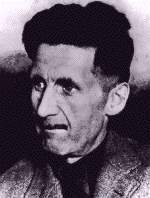 |
| George Orwell |
| 喬治.歐威爾 |
| 圖片來源:http://www.levity.com/corduroy/orwell.htm |
| 主要文類:Novel |
| 資料提供者:Beatrice Hsu/徐慧卿;Kate Liu/劉紀雯;Kevin Yao/姚凱元 |
| 關鍵字詞:20th Cntury British novelist and essayist |
|
|
|
喬治.歐威爾
1903-1950
|
| |
 前言 前言
家庭與教育
緬甸時期
作家生涯的展開
社會主義作家:1930年代
第二次世界大戰
晚年
作為散文家的歐威爾
|
| |
|
| &
nbsp;前言 |
| |
以《動
物農莊》(Animal
Farm)與《1984》(Nineteen
Eighty-Four)兩本政治諷刺小說聞名於世的喬治.歐威爾(George Orwell)乃
是當代最著名的小說家與散文家之一。歐威爾平實的散文風格將政治報導文學帶進藝術的堂奧。閱讀他的文字有如醍醐灌頂之暢快。對他來說,一篇好的文章就要如
同一片窗玻璃一樣,透明、平實、真誠,不帶一點政治味和虛偽,而這也是他一生寫作所堅持的理念。歐威爾描述自己是「下層中的上層中產階級」( "lower-upper-middle
class"),他所要表達的便是身為作家,要為那些被壓迫的人民向任何形式的極權主義宣戰。作家歐威爾便成為那個時代的良
知。
TOP
|
| 家庭與教育 |
| |
喬治.歐威爾本名艾瑞克.亞瑟.布萊爾(Eric Arthur Blair),
於1903年6月23日生於印度朋孟加拉省
的莫提哈利(Motihari,
Bengal, India),為家中老二,上有一姐名為馬嘉列(Marjorie),一
妹名為愛佛瑞兒(Avril)。父親李察.布萊爾(Richard Walmesley Blair)為
一蘇格蘭裔的英國人,曾任印度總督府鴉片局副代理人,而母親艾達.梅培兒.李莫桑(Ida Mabel Limouzin
Blair)的法藉父親則在緬甸從事木材業,而母親則為英國人。兩人於1896年於印度結婚。1904年,艾達為了小孩
子的教育問題,便帶他們回到英國。
身為家中老二,歐威爾因為跟姊妹年齡差距大,以及父親長年在海外工作的關係,他總是感到寂寞、疏離。於是,他便常在獨處時編造故事自
娛,或想像一位虛構的人物與其對話。而這段時間的經歷也影響日後的發展。他在〈我為什麼
寫作?〉("Why
I Write?" 1946)裡描述道:「我很快的發展出不輕易妥協的態度,而這態度使我在求學的日子裡,相當不受歡迎。
[…] 我認為我的文學抱負,從一開始便與疏離與不被重視的情感混合一起了。」歐威爾兒時的讀物為薩克萊(Thackeray)、
吉普齡(Kipling)與
威爾斯(H. G. Wells);
而傑克.倫敦(Jack
London)的《地獄的人民》(The
People of Abyss)則啟發他往後對社會低層人民的關注與憐憫。
歐威爾於5歲時進入位於亨利(Henley)的
一所小型的英國聖公會學校,關於這段求學經歷,歐威爾並沒有在往後的作品中提到。8歲時進入位於伊斯特堡(Eastbourne)的
聖西普安預備學校(St.
Cyprians prep school)就讀。他後來描述在預備學校的生活,像是洗一個「矯情勢利的溫水澡」("a lukewarm bath of
snobbery")。這所學校也是歐威爾第一次體驗到一種極權統治形式的恐怖。在一篇極盡挖苦的文章裡(〈這,
這才是喜悅〉"Such,
Such Were the Joys"出版於歐威爾去世後的1953年),歐威爾正是
處理這段時期的經歷。儘管求學生活上的不如意,他還是因為表現優異,獲得獎學金,並於1917年14歲時進入公立伊頓學校(Eton School)。
伊頓學校乃是公立學校中向來是最有特權、最富裕階級子弟求學的貴族學校。歐威爾在聖西普安預備學校不愉快的經歷,在伊頓學校更是變本加厲,這也使得他鬱鬱
寡歡。儘管歐威爾再如何批評不快樂的伊頓時期,他還是大量學習、累積古典文學的知識,並積極寫詩、劇本與小說。可以說,伊頓自由開明的學習環境,讓歐威爾
具備往後他在探索世界中基本的能力。
TOP
|
| &
nbsp;緬甸時期 |
| |
1921年
從伊頓畢業後,歐威爾並沒有繼續升學,而是選擇進入印度帝國的警察部門,並於緬甸任職。這段從1922年到1927年五年間的經歷成
為他人生中重要的轉淚點。求學時期所憎惡的社會不公,在緬甸具體化為殖民者與被殖民者赤裸的權力關係展現。歐威爾親身經歷所獲得的第一手資料,影響日後他
對政治、社會福利與任何極權統治表現形式的思考。這些衝擊反應在往後所寫的散文與小說中,強調他反帝國主義的思想。在從心理層面來看,帝國主義赤裸的權力
統治,使得身為殖民地警察的歐威爾心中一直有股罪惡感,對殖民地人民的同情與愧疚。因此,歐威爾辭去警察職務回英國後,便決定成為作家,好好補償那些不管
是在亞洲或英國,被不公平對待的人民。
TOP
|
| &
nbsp;作家生涯的展開 |
|
| |
歐威爾生活在巴黎與倫敦兩地,刻意讓自己與社會邊緣人、貧困的勞工與遊民一同生活,並以第一手資料記錄下這群社會下層居民的生活點
滴,為的就是讓他在緬甸當警察時在心中成形的罪惡感有個補償的機會。這些詳實的記錄便出現在1933年,他第一次以筆
名「喬治.歐威爾」所出版的第一本書《巴黎和倫敦的落魄生活》(Down and Out
in Paris and London)。而他為什麼要以筆名而捨棄原本的艾瑞克.布萊爾,或許是因
為怕書銷售差,或是擔心讓雙親丟臉。他仔細挑選筆名的原因,不過是要好好觀察書本的銷售情況,為的是保護他的名聲。最後,結果使他滿意,筆名「喬治.歐威
爾」便成為他往後生命中第二個自我。而歐威爾在緬甸的經驗也給了他許多珍貴、詳實的資料,記錄下英國帝國主義在印度與緬甸的不正當的行為。1931年他以本名艾瑞
克.布萊爾出版的散文〈絞
首刑〉("A
Hanging") 與1936年
出版的著名散文〈射
象〉("Shooting
An Elephant"),便是在描述英國帝國主義的不正當與荒謬。1934年出版的《緬
甸時期》(Burmese
Days)更是一本詳實記錄他在緬甸所觀察到的一切。
TOP
|
|
| 社會主義作家:1930
年代 |
| |
從這個時期開始,歐威爾便一直以一名社會主義作家自處。往後的數年裡,歐威爾曾當過書商助
理、學校老師。而這些經歷也反應在下列所出版的書中:1935年的《牧
師的女兒》(A
Clergyman's Daughter) 與1936年的《讓
葉蘭在風中起舞》(Keep
the Aspidistra Flying),而這些書為他贏得小小的諷刺作家的名聲。1936年歐
威爾在「左翼圖書俱樂部」(the
Left Book Club)的贊助下,前往北英格蘭的維根地區報導失業勞工的情形。這就是1936年出版的《到維根
碼頭之路》(The
Road to Wigan Pier ),一本當代報導文學的里程碑。同年,歐威爾與一名牛津大學心
理學畢業生愛玲.奧修南西 (Eileen
O'Shaugnessy)結婚。婚後的1936年到1940年,歐威爾與愛玲在哈佛郡的佛靈頓(Wallingford,
Hertfordshire)開了一家雜貨店,過著農耕平靜的生活,而這段時其也成為歐威爾一生中最快樂的時光。
但是,1936年
發生的西班牙內戰成為歐威爾另一個生命的轉淚點。身為一名社會主義作家,歐威爾加入西班牙內戰,與一群左翼同伴一起對抗法西斯主義。因為西班牙內戰的衝
擊,他將自己定位為獨立、自由的社會主義者。但是這場「聖戰」不但使歐威爾喉部嚴重受創,差點致命,更使他對「革命」的幻滅。歐威爾沒有參加任何的政黨,
關於這場內戰的經歷,歐威爾記錄在1938年
出版的《卡塔羅尼亞的讚歌》(Homage
to Catalonia)。
TOP
|
| 第二次世界大戰 &
nbsp; |
| |
二次大戰緊接著
西班牙內戰而來。戰時的歐威爾曾擔任過國防市民軍的班長、英國國家廣播公司的記者,並擔任《觀察報》(Observer)、
《論壇報》(Tribune)與
《地平線》(Horizon)
的文字編輯。完成於1944年
但因政治因素延至1945年
出版的《動物農莊》(Animal Farm),
讓歐威爾一躍成為著名的小說家,並使他經濟來源不虞匱乏。《動物農莊》
是一本動物寓言小說,書中大加諷刺蘇聯領導階層與革命的背離。歐威爾運用動物作為現實人物的類比,指出語言的敗壞與共產主義的虛偽的議題。而書中最後的標
語正可說明這些議題:「所有動物都是平等的,但有些動物比其他動物更平等」。隨著小說的出版,他前往德國報導納粹的垮台。但是妻子愛玲卻因一場意外去世。
TOP
|
| &
nbsp;晚年 |
| |
1947年,
歐威爾出版了影響深遠的散文〈政治與英語〉("Politics
and the English Language"),書中表達他對語言的敗壞感到憂心匆匆。大量使用婉轉語,模糊並使真正
意義更加誨澀,換句話說,語言成為極權統治操弄的工具。隨著這篇重要文章的發表,歐威爾也正在醞釀他最為膾炙人口的政治諷刺預言小說。1947年,歐威爾攜養子
李察(Richard)前
往蘇格蘭西海岸外的朱拉島 (the
Scottish island of Jura) 的龐希爾農莊,並在那裡專心寫成《1984》(Nineteen
Eighty-Four),但此時他的健康已日漸惡化。小說於1949年出版,歐威爾因
此跨入英國文學史上一流的小說家之列。書中陰暗、沈重的氣氛正凸顯出在極權統治下人性的扭曲與語言的破壞,正如書中一句標語所顯示的:「戰爭即和平 /
自由即奴役 / 無知即力量」。小說出版的同年,歐威爾與《地平線》雜誌的編輯索妮亞.布勞耐爾結婚。隔年,1950年1月23日因肺結核病逝於倫
敦,享年47歲。
TOP
|
| &
nbsp;作為散文家的歐威爾 |
| |
儘管歐威爾以小說《動物農莊》
與《1984》
聞名,他的散文評論同時也是並列20世
紀最好的散文。在〈我為什麼
寫作?〉與〈政治與英語〉文裡,歐威爾指出作家應藉由寫作來對抗社會不公、壓迫與獨裁統治的力量。他對語言的階級束縛本質上的認識,
影響我們當代的政治論述。〈射
象〉一文即是他早期所寫過優秀的敘事型散文,已顯示出他往後所關心的語言與政治問題。故事的內容雖是描述一段射象的過程,但是他所運
用的散文技巧卻使整個敘事充滿張力與反諷的效果。並使讀者可以深刻的思索英國帝國主義在印度與緬甸的殖民意義。文章中的語言簡單、清晰,沒有任何的婉轉語
去使意義誨澀難懂。正如他所說的,好的散文就要如同一片窗玻璃一樣,透明、平實、真誠,不帶一點政治味和虛偽,而這也是他一生寫作所堅持的理念。
TOP
|
| |
|
|
Orwell, 20th Century
English Novelist and Essayist, Biograpgical Outline
|
1
|
George Orwell
1874-1963
|
| |
| His Family and Education
A. His family
B. Early development of Orwell's literary interest
C. Education
Experience in Burma as a Policeman
Beginning of the Career as a Writer
Socialist Writer: the 1930's
World War II
His later life
Orwell as an Essayist
|
| |
| George
Orwell, famous for his two political satires, Animal
Farm and Nineteen
Eighty-Four, is one of the greatest novelists and
essayists in the world. His energetic prose style helps raise
political-literary journalism to an art. His writing is like a splash
of cold water in the face. For him, writing a good prose should be "as
clear as a windowpane," which also describes his intellectual
integrity. Calling himself "lower-upper-middle class," Orwell wrote to
fight against any form of totalitarianism all his life, and was thus
seen by his contemporaries as the conscience of his age.
|
| His
Family and Education |
| |
A.
His family
- "George
Orwell" was the pseudonym of Eric Arthur Blair, who was born in
Motihar, Bengal, India in 1903 as the second son of Richard Walmesley
Blair and Ida Mabel Limouzin Blair. He had one elder sister named
Marjorie and the younger sister named Avril.
- His father
worked in the Opium Department of the Indian Government. His mother had
lived in Burma with her French teak merchant father. They married in
1896.
- In 1904,
his mother brought him back to England for education.
B. Early
development of Orwell's literary interest
- As the
middle child of his family, Orwell felt lonely since moving back to
England, and developed the habit of making up stories and imaginary
persons to talk to. As he himself described of the time that influenced
his whole life,
I soon developed disagreeable mannerism, which made me unpopular
throughout my schooldays. […] I think from the very start my literary
ambitions were mixed up with the feelings of being isolated and
undervalued. ("Why
I Write?" 1946)
- His
childhood reading was Thackeray, Kipling, and H. G. Wells.
- Jack
London's The People of Abyss (1903) inspired him
to concentrate on the life of
the lower class people of England.
C.
Education
- At the age
of 5, he went to a small Anglican convent school in Henley.
- At the age
of 8, he went to St. Cyprians prep school in Eastbourne, which he
described as "a lukewarm bath of snobbery." This was also the place
that Orwell felt the horror of totalitarianism for the first time. His
bitter essay "Such,
Such Were the Joys," published posthumously in 1953, dealt
with this period.
- At the age
of 14 in 1917, Orwell's good academic performances won him both a
scholarship and admission to Eton, the most famous school for those
wealthy and upper-class students in England.
- The unhappy
memory in St. Cyprians prep school happened again in Eton, which made
Orwell uneasy and perplexed. However, this negative part of his
education did not frustrate Orwell. He learned lots of classics, and
wrote poetry, drama and novels.
- Although
the schooldays at Eton were not happy ones for Orwell, its free and
open learning environment became an abundant soil for Orwell to develop
an independent mind which was equipped with basic abilities to explore
the world.
TOP
|
| Experience
in Burma as a Policeman |
| |
After graduating from Eton, he didn't choose to enter Cambridge or
Oxford University, but joined the Indian Imperial Police in Burma from
1922 to1927. This period of time became a turning point for him. The
social injustice he hated most since his schooldays got embodied then
as power control of the colonizer over the colonized.
- This
firsthand experience partly lead to his life-long concern for politics,
social affair, and any form of totalitarianism, as well as his
expression of anti-imperialism in his later essays and books.
- Psychologically,
the brutal appearance of power relations of imperialism also induced a
sense of guilt in Orwell. He thus decided to make amends for those who
were mistreated and colonized in Asia and in England by being a writer.
TOP
|
| Beginning
of the Career as a Writer |
| |
A.
Living both in Paris and London, Orwell deliberately involved himself
with social outcasts, impoverished laborers, and tramps to experience
and record the life in the lower social class firsthand and to make
amends for his sense of guilt, which was originally shaped in Burma.
- These
experiences resulted in his first book, Down and Out in Paris and
London, published in 1933 under the pseudonym "George Orwell" for the
first time. For fear of the book's being poor sell and of dishonoring
his parents, he carefully selected the pseudonym to protect himself and
observed the result of the publication. The outcome satisfied him, and
the name "George Orwell" thus became his second "self."
B. His
experiences in Burma gave abundant resources for him to write about the
injustice of British imperialism in India and in Burma.
- In 1931, he
published the essay "A
Hanging," and later, in 1936, the famous essay "Shooting
An Elephant." Both essays described his understanding of the
injustice, absurd, of British imperialism.
- In 1934,
the novel Burmese
Days allows the readers to experience what Orwell
experienced in Burma.
TOP
|
| Socialist
Writer: the 1930's |
| |
- In the next
few years, Orwell worked as a bookseller's assistant, schoolmaster. The
publications in the following years made him a reputation of minor
satirical novelist: A
Clergyman's Daughter (1935), and Keep
the Aspidistra Flying (1936), which are all based
on his experiences in different period of his life.
- In 1936
Orwell visited the north of England to produce a documentary account of
unemployment for the Left Book Club. The result was The Road
to Wigan Pier, published in 1936, the milestone of the
reportage of the time.
- In the mean
time, he married Eileen O'shaughnessy, an Oxford graduate and
psychology student. From 1936 to 1940, they moved to Wallingford,
Hertfordshire and ran a grocery. This farming and peaceful life with
Eileen was the happiest time in Orwell's life.
- The turning
point was the Spanish Civil War. As a socialist, Orwell joined the
Spanish Civil War, fighting with the leftist against Fascism; however,
this experience not only made him wounded seriously, but also
eventually disillusioned him. He never joined any political party, but
established himself as an independent left.
- His book
about this period of time in Spain, Homage to Catalonia,
was published in 1938.
TOP
|
| World
War II |
|
| |
- During the
war, Orwell served as a sergeant in the Home Guard and worked as a
journalist for the BBC. He also worked as literary editor in Observer,
Tribune, and Horizon.
- Animal
Farm, finished in 1944 but published in 1945 for
some political reasons, made him a well-known writer and gave him a
secure financial support hereafter. The novel is a fable that satirizes
the leadership of the Soviet Union and the betrayal of a revolution. In
the novel, Orwell tells a story of the animal characters as an allegory
for what he calls "the corruption of language" and the hypocrisy of
communism. The following slogan of the Ethical Treatment of Animals
(PeTA) perfectly shows Orwell's satiric intent : "All animals are
equal, but some animals are more equal than others.. . .A rat is a dog
is a pig is a boy." Though apparently meaning that all animals are
equal, PeTA states that "fighting animals", game chickens and "fighting
breeds" of dogs, do not have even the right to exist.
- While he
was reporting the fall of Germany, his wife died at the age of 40 in
England.
TOP
|
| His
later life |
| |
- In 1947,
Orwell published his influential essay, "Politics and the English
Language," which focused on his observation of the corruption of
language. This was also what Orwell kept emphasizing on the plain style
of prose, not the use of euphemism to obscure the reality and to serve
the tool of totalitarianism.
- Orwell took
his adopted son Richard to the remote Scottish island of Jura, where
his final novel was finished. However, his health was deteriorated.
- The final
novel, Nineteen
Eighty-Four, published in 1949, placed Orwell as
one of the greatest novelists in the history of English literature.
With a dark and uncomfortable atmosphere, the novel presents the twist
of human nature and the destruction of language: "War is Peace /
Freedom is Slavery / Ignorance is Strength."
- In 1949, he
married Sonia Browell, who was an editor of Horizon.
- Because of
tuberculosis, he died in January 23 at the age of 47 in London.
TOP
|
| Orwell
as an Essayist |
| |
- Although
Orwell is best-known for his novel, his essays are among the finest of
the 20th-century. In
"Why I Write?" and "Politics and the English Language,"
Orwell claims that it is the obligation of writers to fight against
social injustice, oppression, and the power of totalitarian regimes.
His view of the class-bounded language has had a deep influence on the
political discourse of our time.
- "Shooting
An Elephant" is the early best narrative essay that Orwell
has ever written. The content of the story is the process of shooting
an elephant; however, the techniques that Orwell applies to the essay
generate the tension and irony of the situation, and make the reader
think more and more deeply about British imperialism in India and
Burma. The language is simple, without any excessive use of modifiers
to help the story proceed. For him, writing a good prose should be "as
clear as a windowpane," which almost describes his own intellectual
integrity.
TOP
|
|
Reference
|
On-Line
Source
BBC Education-Biography. 2 Sep. 2002.
<http://www.bbc.co.uk/programmes/centurions/orwell/orwbiog.shtml>
Bernard Crick. George Orwell: A Life. George Orwell Home. 2 Sep. 2002.
<http://orwell.ru/home.htm>
Essays: George Orwell. 2 Sep. 2002.
<http://www.bedfordstmartins.com/litlinks/essays/orwell.htm>
Jones, Landon Y. George Orwell. People Weekly. Jan. 9, 1984. Charles'
George Orwell Links: The Homepage of Orwell Homepages. 2 Sep. 2002.
<http://pages.citenet.net/users/charles/col-01.html>
Books
Abrams, M. H. The Norton Anthology of English Literature: Volumn 2. 6th
edition. New york: Norton, 1993. 2227-2228. |
| |
|
|
|
|