|
 |
 |
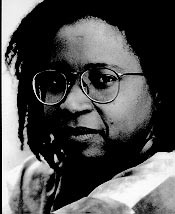 |
| Dionne Brand |
| 布蘭德 |
| 圖片來源:Henry Martinuk |
| 主要文類:Poem |
| 資料提供者:Dr. Kate Liu (劉紀雯) |
| 關鍵字詞:World Literature in English
Carribean Literature |
|
|
|
|
|
 生平 生平
寫作主題
|
| |
| |
|
| 生平 |
| |
TOP
|
| 寫作主題 |
| |
--
布蘭德自稱為是非精英份子(non-elite),女同性戀者和主張馬克斯主義(Silvera)
-- Her views on Trinidad, the Caribbean
and immigrant identity:
布蘭德自稱「逃離」家鄉的,因為當時在千里達她身為一個女孩很受限制
(所以她也是逃離femininity﹔ Silvera
361-63)。但對她而言,她既不住在「那裡」(千里達),也不住在這裡(加拿大),而是在兩者之中(Birbalsingh 1996: 122)。
在她的作品中,她(或她的角色)返鄉的經驗也是負面的,但責任不在加勒比海地
區,而是在以美國為首的新殖民主義和資本主義。
-- Her views on
Canadian Multiculturalism--compared with Bissoondath:
--
對Brand布蘭德和Bissoondath布松達而言,加拿大的多元文化政策會造成種族隔離。
布松達認為多元文化政策造成「一種加拿大式的、溫和的、文化種族隔離政策」
(Hutcheon 315);布蘭德也認為它將加勒比海裔分隔開來,「沒有處理真正的〔政治、經濟上〕的權力問題」(Hutcheon 274)。
但有趣的是,由反對多元文化政策,布松達和布蘭德發展出截然不同的定位政策:
布松達的立場是同化式的:他否定自己的族裔性,主張應該有一個「統一的加拿大
性」(“an across-the-board standard of what it is to be Canadian ”
Hutcheon 316)。
布蘭德則將自己置於黑人文化的中心寫作:每次寫作都會「回去」:不是回千里達,
而是回溯黑人五百年奴隸史(Hutcheon 273)。
TOP
|
| |
| |
|
| |
|
|
| |
|
|
| |
| |
|
| |
| |
|
| |
|
|
| Biography
Interview: Brand Talks about blossom
|
| |
| |
|
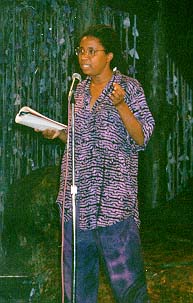
| Biography |
| |
(source:
http://scream.interlog.com/95/brand.html)
A
voice that must be heard.
Toronto Star
Poetry
is here, just here. Something wrestling with how
we live, something dangerous, something honest..
Bread Out Of Stone
Born in Trinidad,
holding degrees from U of T, OISE and currently completing a PhD in
women's history, Dionne's clear, evocative and impassioned
language brings new dimension to discussions of race, gender,
sexuality, politics and class. She has authored five collections of
poetry, a book of children's poetry (Earth Magic),
and a collection of short fiction (Sans Souci and Other
Stories). No Language Is Neutral was nominated for the
Governor General's Award for poetry and, in our humble opinion, should
be on every bookshelf. Just before her Scream reading Coach House Press
released the collection of essays, Bread Out Of Stone,
for which Adrienne Rich has called her a cultural critic of
uncompromising courage. Grammar Of Dissent,
an anthology of work by Dionne, Claire Harris (who was also reading at
the Scream in 1995) and Nourbese Philip (who read in 1994) was
published by Goose Lane. Dionne co-authored Rivers Have
Sources, Trees Have Roots - Speaking of Racism and No
Burden To Carry, an oral history of Black working women. An
accomplished documentary film writer and director, her credits include Older,
Stronger, Wiser and Sisters
In Struggle, and Long
Time Comin'. Other books: Chronicles
of A Hostile Sun, Primitive Offensive, Epigrams to Ernesto Cardenal In
Defense of Claudia, Winter Epigrams and
'Fore Day Morning. Since
the Scream, Dionne has published her first novel, Anywhere
Not Here, to significant acclaim. A new
collection of poetry, Land To Light On
was published by M&S in the Spring of 1997.
TOP
|
| |
| |
|
|
Interview:
Brand Talks about blossom
|
| |
Brand's
view on Blossom
I think that Blossom's
distrust of whites is not based on some personal
craziness of hers. It's based on historical
practice. It is based on historical events that place her as
a black woman in the world at this point in time. …The whites in the
story are not Blossom's only antagonists, though whites might read the
story that way. Blossom's also frees herself of an exploiting husband.
What B hates is suffering and the suffering of black peoples. (Hutcheon 272)
- 276—she
also has a buoyancy. She never thinks of dying. Her anger moves her.
You can be angry about silences and injustice. …And if that anger can
then move ou, I think it's the real answer. In this culture, one tends
to think that anger is destructive. Anger is not an emotion that's only
distinguished by destructiveness. …In fact, B is one of the least angry
of my characters. She is a woman of mighty resilience and quick action.
- 273 I find
myself in the middle of black writing. I'm in the centre of black
writing, and those are the senisbilities that I check to figure out
something that's truthful.
We
are the new wave of Canadian writing. We will write about the internal
contradictions. 277
I finally
decided that I don't live there, and in some ways I don't live here
either, so I live between here and there.
Q: The older
writers had very solid memories of home to fall back on, and they mined
those memories in their writing.
A: I wasn't as
nostalgic, I think, as some of them might have been. I was new. Here I
was being able to make connections with African-Americans. I saw great
hope in that. I didn't long for home at all. I
longed for a past, a kind of validation of my history, which I thought
I could find in a past that was beyond my grandparents. …It
was located somewhere in the consciousness of a people that had to do
with slavery, that other exile.
About
"Blossom" and African tradition 132
That story is based on fact: I met this
woman running a basement speakeasy in her house, and she had run the
speakeasy for years and years. She was a Jamaican woman without a
single tooth in the front of her mouth, and she would throw people out
who were drunk. Also one day I saw an old man xeroxing something. I
thought I'd read over his shoulder and it was all these little potions
he was preparing for people. He was an obeah man and that was obeah
gone modern tech. It's interesting how our people could come
here and adapt things that used to work for them somewhere else so that
they work for them here too.
Gender
issue 133
Q:
In your stories the women have a certain
resilience. The men come and go, like Victor in 'Blossom", but the
women go on apparently forever. Is that particularly Caribbean? Was it
part of your family? …
A: It's very
much what I saw in my family, and what I saw in the other families on
MacGillvray Street. …
Q:
I should think this [subject not being
women] is true for West Indian writing in general. Is it not dominated
by male writers?
A:
It's not just dominated by male writers
but dominated by themselves as subject in it, despite the evidence of
their own lives.
TOP
|
| |
|
|
| |
|
|
|
Reference
|
| |
Birbalsingh,
Frank, ed. Frontiers of Caribbean Literature in
English. London: Macmillan, 1996.
Hutcheon, Linda, & Marion Richmond, eds. Other
Solitudes: Canadian Multicultural Fictions.
Toronto: Oxford UP, 1990.
Silvera,
Makeda. “An interview with Dionne Brand: In the company of my
work.” The Other Woman: Women of Colour in
Contemporary Canadian Literature. Ed. Makeda
Silvera. Toronto: Black Women and Women of Colour P, 1995:
356-81.
|
| |
| |
|
| |
|
|
|
|